

Do We Meet in a Sanctuary?
Leave a comment / 6 minutes of reading

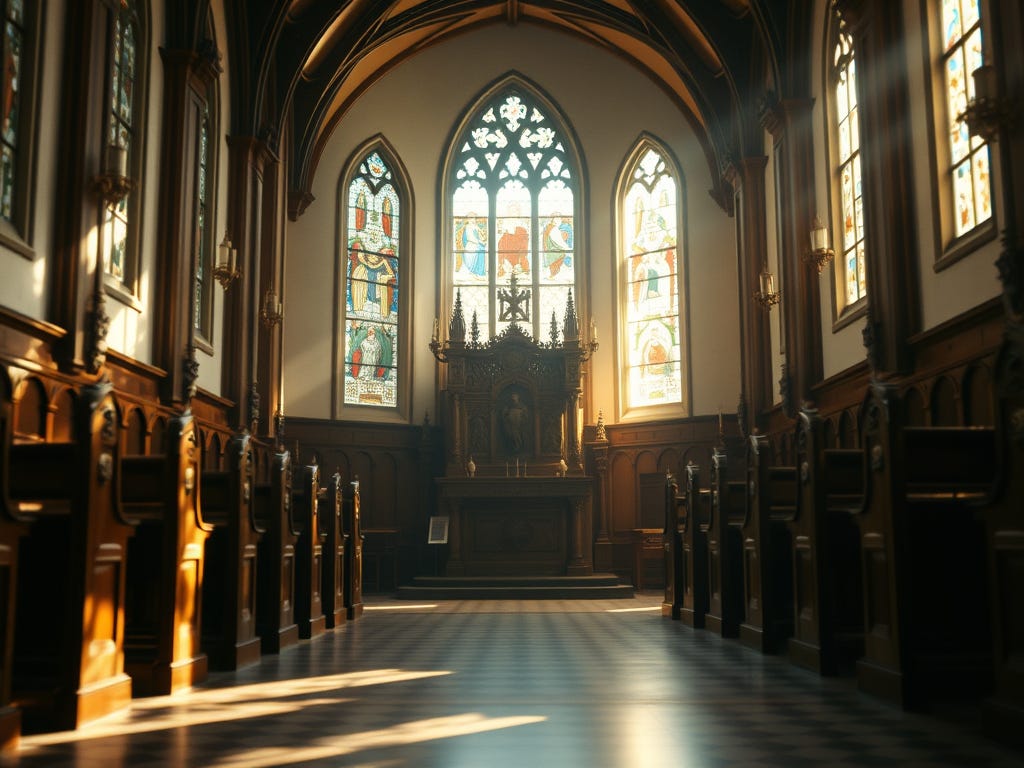
If I said “sanctuary” to you, your first thought would likely be “a place of refuge, a place where someone could go to escape danger.” Indeed, Christianity has a very long tradition of providing places of refuge. But why do many local churches have a room called a sanctuary? I recently asked myself this question. Perhaps you’ve asked yourself the same question. The answer may surprise you!
Sanctuary
Does my church have a sanctuary? If the leadership of your church says it does, then it does. Is it okay to ornately decorate the sanctuary? Yes, God loves beauty. Is it okay to have paintings that show events in the Bible? Absolutely. Is an altar okay? The term “altar” is a bit problematic, but having a place to kneel and pray is very appropriate.
Growing up, my family was always on the move. One funny thing I noticed at each church we joined was how grown-ups would always give children those serious looks and tell us not to run in the sanctuary!
In these churches, the term “sanctuary” applied to the room where the congregation met to sing hymns, pay tithes, listen to the choir, and hear soul-stirring sermons preached by the pastor. There was an implied holiness to these sanctuaries because the room itself was sacred (i.e., dedicated to a religious purpose), which was why no one should run in it, especially kids!
A Brief History of Sanctuaries
The idea of religious sanctuaries stretches back into the mists of time and remains today in many religions. Pagans had dedicated places to worship their false gods and to perform their religious rites1. The Israelites had the “tent of meetings2” and the first and second temples in Jerusalem that were sacred and holy. But when it comes to Christianity, something unexpected happened.
The earliest Christians didn’t use the term ” sanctuary ” because they didn’t have sacred and holy places. For the first few hundred years after the birth of the Church3, Early Christians generally met in people’s homes4, rented rooms5, schools6, or in the temple (until it was destroyed)7. It wasn’t until the 4th century A.D. that the idea of a Christian “sanctuary” came into being8.
This is understandable since churches were, and still are, communities of Christians, not buildings9. If we believe that we are entering a holy room, that’s a problem. By the Holy Spirit living in us, we bring holiness with us when we enter a room.
What To Do With 3,000 New Believers
Stop for a moment and think about what happened in the 2nd chapter of Acts. The Apostle Peter preached, and about 3,000 people were saved10. Now, what did Luke write about after this vast number of Christians were added to the Church? Did he write about building a building? No. He wrote, “And they devoted themselves to the apostles’ teaching and the fellowship, to the breaking of bread and the prayers11.”
There was a vertical emphasis by praying to God and a very strong horizontal emphasis on person-to-person community—learning, fellowship, and eating meals together. But there is no mention of Christians acquiring a building or even hiring an architect! In fact, nowhere in the New Testament are we told about Christians building a “church building.”
It’s Not the Building
There is nothing wrong with Christians coming together and building/buying places for Christians to meet. Purchases can be made communally, through missionary organizations, by denominations, locally, and so forth. But, we must not look to things made by human hands to bolster our faith.
In the Book of James, we are told, “Pure and genuine religion in the sight of God the Father means caring for orphans and widows in their distress and refusing to let the world corrupt you12.” True religion is about spiritual maturity and person-to-person ministry. This is why many Christians say that Christianity is not a religion; it’s a relationship with Jesus.
Worshiping God
It was not a mere conversation when Jesus talked with the Samaritan woman at the well. Surprisingly, angels didn’t herald this meeting with shouts. In this conversation, Jesus made a declaration that split history in two.
Before His declaration, there were many sacred places, physical places where people went to worship God. Jerusalem itself was one of those sacred places, and for the Jews, the temple in Jerusalem was the most sacred of sacred places in which to worship God. But Jesus changed all of that when He spoke at the well.
Jesus said to her, “Woman, believe me, the hour is coming when neither on this mountain nor in Jerusalem will you worship the Father. You worship what you do not know; we worship what we know, for salvation is from the Jews. But the hour is coming, and is now here, when the true worshipers will worship the Father in spirit and truth, for the Father is seeking such people to worship him. God is spirit, and those who worship him must worship in spirit and truth.” - John 4:21-24 ESV
This statement is astonishing. Jesus sets the physical places of worship — a mountain in Samaria and Jerusalem in Judea—against the spirit. From now on, true worshipers will worship the Father in spirit and truth. We no longer need to go to a place to gain an advantage when worshiping God. There no longer remain any special places for worship. Also, notice that Jesus said the Father is seeking such people to worship him. This is amazing!
In the New Testament, we are told of only one place that comes close to being sacred (i.e., dedicated to a religious purpose and so deserving of veneration).
But when you pray, go into your room and shut the door and pray to your Father who is in secret. And your Father who sees in secret will reward you. - Matthew 6:6 ESV
Early Chuch Evidence De-emphasizes Buildings
For the Early Church, rooms, buildings, or places were no longer valuable to Christians besides providing shelter. Justin Martyr was martyred in 160 A.D. Rusticus, a [Roman] prefect, asked Justin, “’ Where do you assemble?‘ Justin said, ‘Where each one chooses and can: for do you fancy that we all meet in the very same place? Not so; because the God of the Christians is not circumscribed [organized] by place; but being invisible, fills heaven and earth, and everywhere is worshipped and glorified by the faithful.‘ 13 ” Around this same time, Clement of Alexandria14 wrote, “The Word, prohibiting all sacrifices and the building of temples, indicates that the Almighty is not contained in anything.15”
At Dura-Europos, in Syria, archeologists found what is possibly the oldest building used as a church. It was built in 232 AD and is called a domus ecclesiae, meaning a house converted into a church. What’s interesting is that some archeologists now think that this house church continued to be used as a home while also serving as a meeting place for Christians, complete with a room converted into a baptistry16.
Conclusion
When Jesus died on the cross, the curtain in the temple that hid the “holy of holies” was torn from the top to the bottom, removing any separation between God and His children17. As Christians, we are alive in Jesus18. The Lord dwells in us as believers19. Nowhere on Earth is there a place where we can go for greater access to God.
Footnotes
Primary Sources
Bible References
The Editors of Encyclopedia Britannica. (2023). sanctuary. In Encyclopedia Britannica. ↩︎
Exodus 33:7 – The Tent of Meeting. (n.d.). Bible Hub. Retrieved September 2, 2024, from
https://biblehub.com/exodus/33-7.htm ↩︎Bible Gateway passage: Acts 2 – English Standard Version. (n.d.). Bible Gateway. Retrieved September 2, 2024, from https://www.biblegateway.com/passage/?search=Acts%202&version=ESV ↩︎
Bible Gateway passage: Acts 1:12-13 – New King James Version. (n.d.). Bible Gateway. Retrieved September 2, 2024, from https://www.biblegateway.com/passage/?search=Acts%201%3A12-13&version=NKJV ↩︎
Bible Gateway passage: Acts 1:12-13 – New King James Version. (n.d.). Bible Gateway. Retrieved September 2, 2024, from https://www.biblegateway.com/passage/?search=Acts%201%3A12-13&version=NKJV ↩︎
Bible Gateway passage: Acts 19:9 – New King James Version. (n.d.). Bible Gateway. Retrieved September 2, 2024, from https://www.biblegateway.com/passage/?search=Acts%2019%3A9&version=NKJV ↩︎
Bible Gateway passage: Acts 2:46 – New King James Version. (n.d.). Bible Gateway. Retrieved September 2, 2024, from https://www.biblegateway.com/passage/?search=Acts%202%3A46&version=NKJV ↩︎
The Editors of Encyclopedia Britannica. (2023). sanctuary. In Encyclopedia Britannica. ↩︎
Díaz-Pabón, P. L. Á. (2018, October 1). What Is the Church? It’s Role and Purpose According to the Bible. Bible Study Tools; Salem Web Network. https://www.biblestudytools.com/bible-study/topical-studies/what-is-the-church-according-to-the-bible.html ↩︎
Acts 2:41 – Three Thousand Believe. (n.d.). Bible Hub. Retrieved September 2, 2024, from
https://biblehub.com/acts/2-41.htm ↩︎Bible Gateway passage: Acts 2:42 – English Standard Version. (n.d.). Bible Gateway. Retrieved September 2, 2024, from https://www.biblegateway.com/passage/?search=Acts%202%3A42&version=ESV ↩︎
James 1:27 – Hearing and Doing. (n.d.). Bible Hub. Retrieved September 2, 2024, from
https://biblehub.com/james/1-27.htm ↩︎Assembly, Christian Quotes. (2024, July 31). Ante-Nicene Christianity.
https://ante-nicenechristianity.com/dictionary/assembly-christians ↩︎Wikipedia contributors. (2024, August 10). Clement of Alexandria. Wikipedia, The Free Encyclopedia. https://en.wikipedia.org/w/index.php?title=Clement_of_Alexandria&oldid=1239641429 ↩︎
Bosque, J. (2013, September 23). God’s House and Church Building Idolatry. Gods Leader.
https://godsleader.com/church-building-idolatry/ ↩︎The Christian Building at Dura-Europos: Rethinking the Archaeology of the World’s Oldest House Church. (2024, July 1). American Journal of Archaeology. https://www.ajaonline.org/article/4806 ↩︎
Bible Gateway passage: Matthew 27:50-51 – English Standard Version. (n.d.). Bible Gateway. Retrieved September 2, 2024, from https://www.biblegateway.com/passage/?search=Matthew%2027%3A50-51&version=ESV ↩︎
Bible Gateway passage: Hebrews 10:19-22 – English Standard Version. (n.d.). Bible Gateway. Retrieved September 2, 2024, from https://www.biblegateway.com/passage/?search=Hebrews%2010%3A19-22&version=ESV ↩︎
1 Corinthians 3:16 – You are God’s Temple. (n.d.). Bible Hub. Retrieved September 12, 2024, from https://biblehub.com/1_corinthians/3-16.htm ↩︎